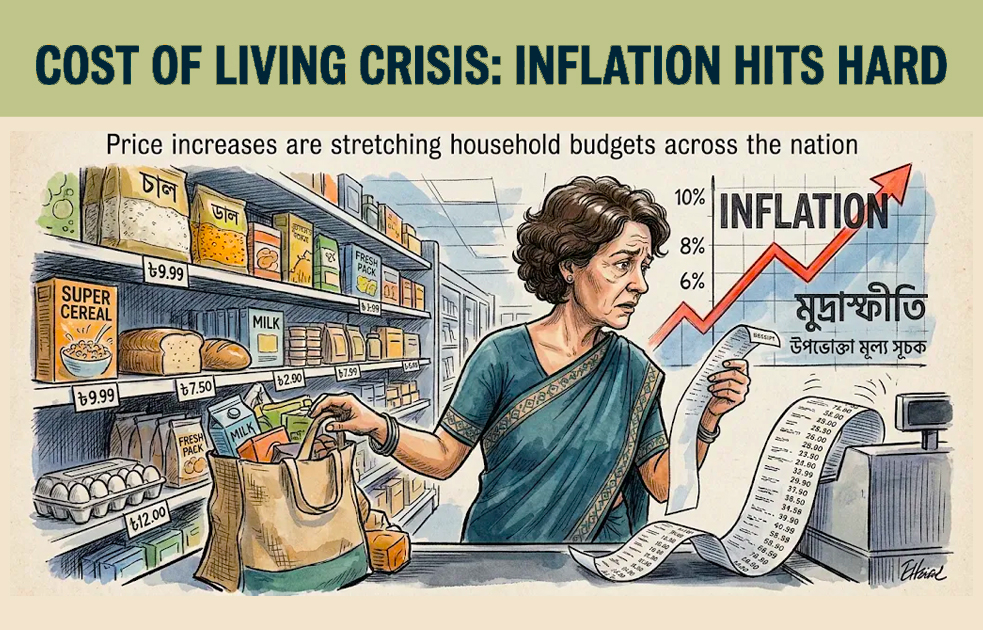
Flipping through newspaper pages or glancing at television screens these days, an encouraging headline frequently catches the eye: "Inflation has eased somewhat" or "The temperature of inflation is cooling down." From a statistical standpoint, these reports may offer a glimmer of relief—what economists might term a positive correction in macroeconomic indicators. But the question remains: whether the national or macroeconomic inflation rate dropped or increased by a fraction of a percent, has the weight of the market bag grown even a fraction lighter? What do the household accounts in ordinary kitchens say? The reality is quite ruthless; even if the inflation line dips slightly on statistical charts, not an iota of anxiety or hardship has lessened in the lives of ordinary people ground down by the high costs of essential commodities.
The Conflict between Statistics and Reality
Economics is a science that often speaks purely through the manipulation of numbers, ignoring human emotion. A decrease in inflation does not mean that goods have become cheaper. In plain language, it means that the speed at which prices are rising has slowed down compared to before. In other words, the whirlwind pace at which the price of rice was skyrocketing a year ago has perhaps lost some of its storm-like speed today, but the price level has not dropped; rather, a new stability has settled in at that sky-high price.
Let us consider a simple example. If the price of a product rises from 100 Taka to 150 Taka last year, and then climbs to 155 Taka this year, economists will declare that the rate of inflation has decreased. Yet, from the pocket of an ordinary consumer, ultimately 155 Taka—not 150—has been spent! The scope of their monthly income has not expanded in proportion. As a result, this statistical juggling act not only confuses ordinary people, but it feels to them like a cruel mockery.
The Endless Struggle of the Middle and Lower Classes
Survival today feels like an endless war. Whether in the city or the suburbs, the picture is identical everywhere. Fixed-income earners—namely the middle and lower classes—are facing the gravest crisis. House rent, children's school tuition, transportation expenses, and above all, the runaway prices of food items have reached such a level that people are now forced to cut their consumption in half.
Where people once thought at least twice before purchasing fish or meat, they now have to calculate even before buying eggs or vegetables. With the supply of protein dwindling, the younger generation is silently falling victim to malnutrition. In lower-middle-class households where savings are out of the question and debt is required just to survive the month, what impact could a marginal drop in inflation possibly have? It is akin to trying to quench a desert thirst with a mirage in the middle of the sea.
Income Stagnation and Expense Compression
The working class and salaried employees have borne the brunt of this long-term inflation shock. Even though market prices have doubled in a single leap, the wages or salaries of most people have failed to increase proportionally over the past few years. Although some government or private institutions have granted minor salary increments, they have fallen entirely short of matching the actual cost of living. Consequently, people's purchasing power is continually shrinking.
People are forced to omit not just non-essential items, but deeply vital ones from their expense lists. Bearing medical costs has now become a luxury for many. Given how rapidly medicine prices are soaring, ordinary patients can forget about quality treatment; they struggle simply to purchase basic prescription drugs. Under such conditions, whether the inflation index dropped by zero point one or two percent makes virtually no difference to anyone.
The Distance Between Policymakers' Thinking and Ground Reality
The calculations made by policymakers and economic planners in air-conditioned rooms are worlds apart from reality on the ground. They speak of various complex theoretical measures to control inflation, such as raising interest rates or contracting the money supply. While the long-term benefits of these steps may eventually surface in the economy, who will bear responsibility for the extreme suffering ordinary people endure during the interim transition?
Although market monitoring and breaking up syndicates are frequently discussed on paper, no permanent benefits are visible in practice. Occasional mobile courts are operated, yet the manipulations of major business syndicates and the unchecked profiteering of retail markets remain uncurbed. Until sustainable systems are established to deliver goods to ordinary people at affordable prices, this so-called decline in inflation will remain trapped merely on paper.
Conclusion
In a healthy and normal society, inflation should not paralyze human life—that is the baseline expectation. But given our current global and domestic economic standing, promoting a fractional drop in the index as a major achievement is nothing short of self-deception. Ordinary people do not care to understand statistics; they simply want the assurance that their hard-earned income will provide their families with at least two square meals a day and the dignity to survive.
Until the tangible benefits reach the shopping bag, this "news of slight relief" will remain nothing more than a cruel joke. Policymakers must step out from behind numerical calculations, look ordinary citizens in the eye, and enforce practical, rigorous measures that can genuinely restore peace and relief to everyday life.
Financial Mirror/AH