When the first bulk freighter of the week casts off from the jetties at Chattogram, it carries more than just standard freight. Inside those stacked steel containers sits the output of an economic engine that has quietly redrawn the global supply map. As Bangladesh navigates its transition toward a fully recognized developing economy, its growth is anchored by ten distinct sectors that command significant positions in the global marketplace.
1. The Looming Giant: Ready-Made Garments
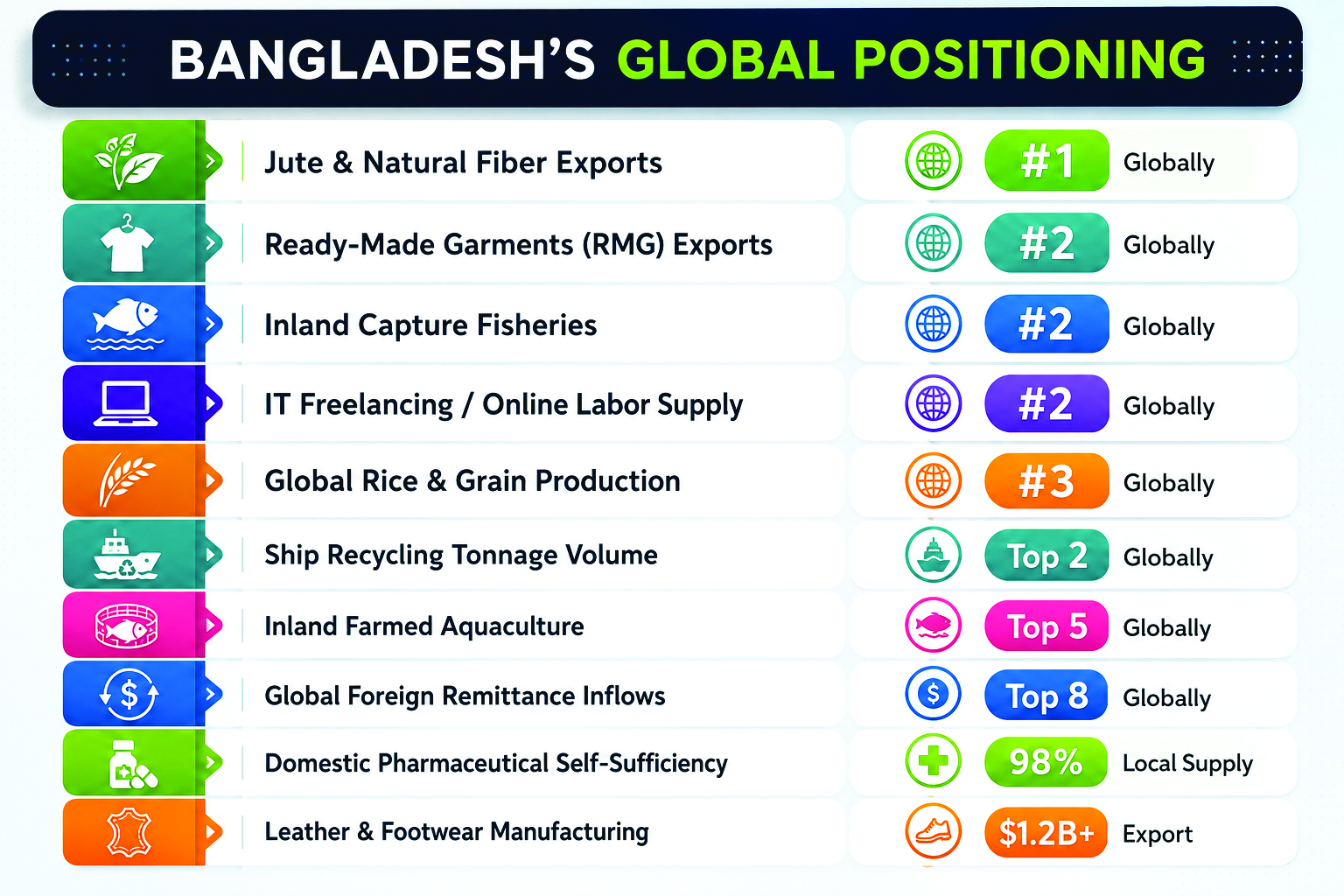
High above the factory floors of Gazipur and Narayanganj, solar arrays catch the morning sun—a visible sign of the nation’s push toward sustainable manufacturing. Housing the world’s highest density of USGBC LEED-certified green garment facilities, Bangladesh stands firm as the world’s second-largest apparel exporter (Source: WTO World Trade Statistical Review; Export Promotion Bureau).
Generating over $38 billion in export revenue, the sector has evolved from basic stitching into high-tech, automated knitwear and sustainable denim production.
2. The Golden Strand: Jute & Natural Fibers
Long before synthetic polymers dominated global packaging, jute was Bangladesh’s premier export. Today, as international regulations clamp down on single-use plastics, the “Golden Fiber” is experiencing a global resurgence. Bangladesh commands the #1 position worldwide in raw jute and yarn exports (Source: FAO Commodity Statistics; Ministry of Textiles and Jute), supplying biodegradable packaging, geo-textiles, and automotive interior linings to eco-conscious global markets.
3. The Water Network: Inland Fisheries
Along the delta’s river systems and coastal enclosures, modern aquaculture techniques have transformed traditional fishing into an industrial pillar. Ranked 2nd globally in inland capture fisheries and among the top 5 in farmed aquaculture (Source: FAO SOFIA Report; Department of Fisheries), the country’s waters supply both domestic protein needs and international seafood buyers seeking high-value frozen shrimp and white fish.
4. The Delta’s Harvest: Rice & Grain Resilience
Despite persistent land constraints and unpredictable seasonal weather, the country’s agricultural sector yields over 38 million metric tons of staple grain annually. Driven by climate-resilient seed varieties developed by local researchers, Bangladesh ranks as the world’s 3rd largest rice producer (Source: USDA World Agricultural Production Report; BBS), maintaining national food security while exporting aromatic rice and processed foods to diaspora markets across the Middle East and Europe.
5. The Digital Wallet: Mobile Financial Services
In remote village markets and dense urban trading hubs alike, financial transactions no longer depend on physical bank branches. Powered by platforms like bKash and Nagad, Bangladesh’s Mobile Financial Services (MFS) ecosystem serves over 100 million active accounts. Recognized globally as a pioneer in digital financial inclusion (Source: Bangladesh Bank Payment Systems Dept.; GSMA), the system processes billions of Taka daily in peer-to-peer transfers, merchant payments, and micro-loan distributions.
6. The Code Frontier: IT & Online Labor
In quiet study rooms and tech incubators across Dhaka, Rajshahi, and Chattogram, hundreds of thousands of young professionals operate on global time zones. Ranking 2nd globally in online labor supply (Source: Oxford Internet Institute Online Labour Index; ICT Division), Bangladesh’s software developers, graphic designers, and AI-annotation specialists generate over $1.5 billion in service exports and gig-economy income.
7. The Heavy Recyclers: Ship Breaking & Steel
Along the coast of Sitakunda, massive retired ocean liners are systematically dismantled. Operating as one of the top 2 ship recycling nations by tonnage volume (Source: UNCTAD Review of Maritime Transport; Ministry of Industries), this heavy industry feeds millions of tons of recycled scrap iron directly into domestic steel mills, supplying the rebar needed for national mega-infrastructure projects.
8. Medicine Sovereignty: Pharmaceuticals
In state-of-the-art manufacturing plants scattered across Savar and Dhamrai, local pharmaceutical firms produce everything from basic antibiotics to complex oncology treatments. Meeting 98% of all domestic medicine demand (Source: Directorate General of Drug Administration - DGDA; BAPI), the sector exports WHO-standard generic formulations to more than 140 countries, proving that a developing nation can achieve full therapeutic self-reliance.
9. Crafted Value: Leather & Footwear
Drawing on deep local supplies of hide and expanding processing facilities, the leather and footwear industry generates over $1.2 billion annually (Source: Export Promotion Bureau; LFMEAB). Serving as the country’s second-largest manufacturing exporter, the sector has transitioned from raw leather trading to manufacturing high-end footwear and travel accessories for international fashion brands.
10. The Human Capital Bridge: Remittance & Labor
From construction sites in the Gulf to technology projects in East Asia, Bangladeshi workers abroad send back a critical financial stream. Ranking among the top 8 remittance recipient nations globally (Source: World Bank Migration and Development Brief; Bangladesh Bank), annual inflows exceeding $20 billion bolster central bank reserves and fund rural household development across the nation.
The Road Ahead
As duty-free quotas and trade preferences evolve in the coming years, these ten sectors represent the core of Bangladesh’s modern economic strategy. By combining high-volume industrial capacity with rapid digital adoption, the country continues to establish a firm, resilient footprint on the international stage.